Circulan por internet y en los medios diversos estudios y rumores sobre supuestas anomalías en el flujo de datos del PREP y el cómputo distrital. Usando los datos casilla por casilla del IFE, hice un análisis estadístico (nada sofisticado, ojo) que espero despeje algunas dudas.
Las conclusiones son simples pero merecen recalcarse: el sesgo urbano explica el flujo de datos del PREP, y el sesgo partidista explica el cómputo distrital.
Pueden verlo en esta liga:
http://www.cide.edu/investigadores/aparicio/elecciones/
Si les parece interesante, ojalá puedan difundirlo a sus contactos.
Addendum: la presentación ha sido actualizada (25-julio-2006)
Monday, July 24, 2006


Sunday, July 23, 2006
The secret to wisdom: Strong opinions, weakly held
Some words of wisdom from management-guru Bob Sutton:
"...virtues of wise people – those who have the courage to act on their knowledge, but the humility to doubt what they know – is one of the main themes in Hard Facts. (...) Perhaps the best description I’ve ever seen of how wise people act comes from the amazing folks at Palo Alto’s Institute for the Future.
A couple years ago, I was talking the Institute’s Bob Johansen about wisdom, and he explained that – to deal with an uncertain future and still move forward – they advise people to have “strong opinions, which are weakly held.” They've been giving this advice for years, and I understand that it was first developed by Instituite Director Paul Saffo. Bob explained that weak opinions are problematic because people aren’t inspired to develop the best arguments possible for them, or to put forth the energy required to test them. Bob explained that it was just as important, however, to not be too attached to what you believe because, otherwise, it undermines your ability to “see” and “hear” evidence that clashes with your opinions. This is what psychologists sometimes call the problem of “confirmation bias.”
Here's a somewhat more elegant variation: "Fierce opinions, briefly held, quietly disowned."
"...virtues of wise people – those who have the courage to act on their knowledge, but the humility to doubt what they know – is one of the main themes in Hard Facts. (...) Perhaps the best description I’ve ever seen of how wise people act comes from the amazing folks at Palo Alto’s Institute for the Future.
A couple years ago, I was talking the Institute’s Bob Johansen about wisdom, and he explained that – to deal with an uncertain future and still move forward – they advise people to have “strong opinions, which are weakly held.” They've been giving this advice for years, and I understand that it was first developed by Instituite Director Paul Saffo. Bob explained that weak opinions are problematic because people aren’t inspired to develop the best arguments possible for them, or to put forth the energy required to test them. Bob explained that it was just as important, however, to not be too attached to what you believe because, otherwise, it undermines your ability to “see” and “hear” evidence that clashes with your opinions. This is what psychologists sometimes call the problem of “confirmation bias.”
Here's a somewhat more elegant variation: "Fierce opinions, briefly held, quietly disowned."
Wednesday, July 19, 2006
Especulaciones sobre PREP y Conteo Distrital
Circulan en internet diversos análisis sobre las supuestas anomalías del PREP y del conteo distrital. Sin hacer un juicio sumario sobre la calidad de estos estudios, la mayoría de ellos han sido usados como argumentos para sustentar la hipótesis del fraude cibernético. Celebro estos análisis que explotan la transparencia (a veces tardía, pero transparencia al fin) y los datos divulgados por el IFE. Lo malo del asunto es que ni los medios ni los ciudadanos comunes saben mucho de estadística y entonces es fácil que unos y otros se vayan con la finta... Otro problema no menor es que aún los expertos pueden ver moros con tranchete si parten de supuestos equivocados. Veamos.
¿Anomalías o sesgo urbano y partidista?
Dos hipótesis sugeridas por muchos pero que casi nadie ha puesto a prueba, o de plano la descartan prima facie, es 1) el sesgo urbano en el flujo de datos del PREP y 2) el sesgo partidista en el conteo distrital.
Los datos planos del PREP, hechos disponibles recientemente por el IFE, incluyen una variable donde distinguen entre casillas rurales y urbanas. El PAN aventajó en zonas urbanas y no tanto en las rurales. Ex-post, tambien sabemos en qué estados o distritos ganó FC y en cuáles AMLO. Con tales datos se pueden hacer fácilmente las siguientes pruebas:
En cuanto al conteo distrital, pronostico que los computos avanzaron mas rápido en los distritos o estados pro-AMLO, que en los estados pro-Calderón. Esto no es aleatorio, sino fruto de que los comités distritales donde ganó Calderón sostuvieron mayores debates casilla por casilla que los de su rival--lo cual retardó su captura. Al final, si el PREP y el conteo rápido no mintieron, tenia que haber cruce en favor de FC... tal como ocurrió.
(a ver si tengo tiempo de probar estas hipótesis)
Expertos y supuestos equivocados
De manera más general hay que aclarar otras cosas. Muchos expertos han analizado el flujo de datos del PREP y el CDA como si ambos fueran producto de procesos 1) aleatorios, 2) independientes o 3) muestrales. Los tres supuestos son falsos.
NO ALEATORIEDAD. Es obvio que el flujo de datos depende de factores no aleatorios como el huso horario de los estados y la urbanizacion de los distritos y casillas. Además, la capacidad de escrutinio, cómputo y llenado de actas de los funcionarios de casilla tampoco está distribuida aleatoriamente en nuestro país--por las mismas tristes razones que la escolaridad tampoco es uniforme a lo largo del país. Otras cosas si son mas o menos aleatorias: la tasa de participación, si la casilla abrió y cerró a tiempo, si había cola a las 6pm, o si llovía esa noche.
DEPENDENCIA. No se deben analizar los votos o porcentajes de un candidato de manera independiente al de otros. Existen muy claros sesgos partidistas y de participacion que varían entre regiones, estados y distritos. Esto es evidente cuando se comparan los histogramas de frecuencias de FC y AMLO: cuando el voto de un candidato es más disperso el del otro es más concentrado. Por ejemplo, en algunos estados el voto priísta afectó más al PRD que al PAN y viceversa. Incluso el voto por partidos chicos como NA y ASDC a veces afectó o benefició a PAN y PRD.
NO MUESTRAL. Algunos expertos insisten en que debió haber habido múltiples cruces en el PREP y en el CDA, dada la aleatoriedad del proceso. Pero aún en una eleccion reñida como esta, si las condiciones inciales del flujo de datos favorecían suficientemente a un candidato no tiene por qué haber cruces o bien, dado el caso, sólo un cruce (es decir, más que random walks, hubo path dependence en el flujo de datos). Como explique más arriba es posible que el PREP haya comenzado con tal ventaja para Calderón que esta solo se redujera sin revertirse; por otro lado el CDA favoreció inicialmente a AMLO... hasta que hubo uno y sólo un cruce.
Finalmente, poco se ha dicho del conteo rápido--instrumento muestral que, a diferencia del PREP, en efecto estaba diseñado para pronosticar el resultado. El conteo rápido SI fue una muestra aleatoria y representativa de las casillas y, en efecto, mostró muchos cruces conforme las casillas reportaban sus datos--tal y como era obvio esperar.
El conteo rápido hubiera podido detectar un "vencedor probable" el mismo domingo si el margen de diferencia era mayor a 0.6%. Pero los ciudadanos decidieron dar una ventaja ligeramente menor: 0.58%... que dejó mudo al conteo. De nuevo, algunos verán en este hecho una prueba más de la maquinación fraudulenta. Yo lo que veo es una elección apretadísima como las que ocurren de vez en vez a lo largo del planeta.
¿Anomalías o sesgo urbano y partidista?
Dos hipótesis sugeridas por muchos pero que casi nadie ha puesto a prueba, o de plano la descartan prima facie, es 1) el sesgo urbano en el flujo de datos del PREP y 2) el sesgo partidista en el conteo distrital.
Los datos planos del PREP, hechos disponibles recientemente por el IFE, incluyen una variable donde distinguen entre casillas rurales y urbanas. El PAN aventajó en zonas urbanas y no tanto en las rurales. Ex-post, tambien sabemos en qué estados o distritos ganó FC y en cuáles AMLO. Con tales datos se pueden hacer fácilmente las siguientes pruebas:
- Comparar medias de votos PAN/PRD/PRI en casillas rurales y urbanas
- Ritmo y velocidad de captura en PREP en casillas rurales y urbanas
- Velocidad de captura en CDA en estados donde gano AMLO vs. FC.
En cuanto al conteo distrital, pronostico que los computos avanzaron mas rápido en los distritos o estados pro-AMLO, que en los estados pro-Calderón. Esto no es aleatorio, sino fruto de que los comités distritales donde ganó Calderón sostuvieron mayores debates casilla por casilla que los de su rival--lo cual retardó su captura. Al final, si el PREP y el conteo rápido no mintieron, tenia que haber cruce en favor de FC... tal como ocurrió.
(a ver si tengo tiempo de probar estas hipótesis)
Expertos y supuestos equivocados
De manera más general hay que aclarar otras cosas. Muchos expertos han analizado el flujo de datos del PREP y el CDA como si ambos fueran producto de procesos 1) aleatorios, 2) independientes o 3) muestrales. Los tres supuestos son falsos.
NO ALEATORIEDAD. Es obvio que el flujo de datos depende de factores no aleatorios como el huso horario de los estados y la urbanizacion de los distritos y casillas. Además, la capacidad de escrutinio, cómputo y llenado de actas de los funcionarios de casilla tampoco está distribuida aleatoriamente en nuestro país--por las mismas tristes razones que la escolaridad tampoco es uniforme a lo largo del país. Otras cosas si son mas o menos aleatorias: la tasa de participación, si la casilla abrió y cerró a tiempo, si había cola a las 6pm, o si llovía esa noche.
DEPENDENCIA. No se deben analizar los votos o porcentajes de un candidato de manera independiente al de otros. Existen muy claros sesgos partidistas y de participacion que varían entre regiones, estados y distritos. Esto es evidente cuando se comparan los histogramas de frecuencias de FC y AMLO: cuando el voto de un candidato es más disperso el del otro es más concentrado. Por ejemplo, en algunos estados el voto priísta afectó más al PRD que al PAN y viceversa. Incluso el voto por partidos chicos como NA y ASDC a veces afectó o benefició a PAN y PRD.
NO MUESTRAL. Algunos expertos insisten en que debió haber habido múltiples cruces en el PREP y en el CDA, dada la aleatoriedad del proceso. Pero aún en una eleccion reñida como esta, si las condiciones inciales del flujo de datos favorecían suficientemente a un candidato no tiene por qué haber cruces o bien, dado el caso, sólo un cruce (es decir, más que random walks, hubo path dependence en el flujo de datos). Como explique más arriba es posible que el PREP haya comenzado con tal ventaja para Calderón que esta solo se redujera sin revertirse; por otro lado el CDA favoreció inicialmente a AMLO... hasta que hubo uno y sólo un cruce.
Finalmente, poco se ha dicho del conteo rápido--instrumento muestral que, a diferencia del PREP, en efecto estaba diseñado para pronosticar el resultado. El conteo rápido SI fue una muestra aleatoria y representativa de las casillas y, en efecto, mostró muchos cruces conforme las casillas reportaban sus datos--tal y como era obvio esperar.
El conteo rápido hubiera podido detectar un "vencedor probable" el mismo domingo si el margen de diferencia era mayor a 0.6%. Pero los ciudadanos decidieron dar una ventaja ligeramente menor: 0.58%... que dejó mudo al conteo. De nuevo, algunos verán en este hecho una prueba más de la maquinación fraudulenta. Yo lo que veo es una elección apretadísima como las que ocurren de vez en vez a lo largo del planeta.
Tuesday, July 11, 2006
Sólo EL sabe sumar
Federico Reyes Heroles, en Reforma (11/jul/06), lo dice mejor que muchos:
PERDER GANANDO
¿Cuál es el límite? La alianza por el Bien de Todos está en su derecho de impugnar las supuestas irregularidades habidas en la elección. Auténticamente es por el bien de todos: sólo desnudando anomalías y posibles delitos electorales es como podremos arrinconarlas. Todo sistema electoral se perfecciona por actos de tracto sucesivo. En el 88 las actas no quedaban en manos de los partidos. En el 91 los partidos carecían de representantes en un buen número de las casillas. Las zonas alejadas tuvieron que ser cubiertas por un auténtico ejército de observadores. La fiscalía especial es otro paso. Denunciar irregularidades y anomalías es obligado e imprescindible para el avance democrático. Allí no hay discusión. Pero se plantea algo distinto.
¿Cuál es el límite, dónde está la frontera que divide lo que es un acto jurídico responsable de una treta política para desorientar a la opinión pública? ¿De verdad creen que hubo irregularidades intencionales en 50 mil de las 130 mil casillas? De verdad creen que el PREP, el conteo y el cómputo distrital -cuyos resultados coinciden al dedillo- fueron manipulados? Piensan entonces que hubo un silencioso golpe de Estado en el IFE que involucró a cientos de servidores públicos, incluidos científicos de gran renombre, golpe de Estado del cual nadie se dio cuenta, por cierto, ni ellos. Una operación central de ese tipo involucraría a decenas de miles de ciudadanos. Allí el asunto no cuadra. ¿Ignorancia o perversidad? No todas las aventuras que parecen quijotescas terminan bien. Don Quijote leyó novelas de caballería, AMLO encuestas a destiempo.
Convertido en Presidente virtual durante dos años, se vio mucho tiempo en la silla presidencial. Los medios colaboraron a ello mes a mes: 10, 15, 20 puntos de ventaja. Pero, ¿quiénes eran los competidores reales, en qué situación? Faltaba mucho por definir. ¡Voy ganando! Soy indestructible, acabaré con las pensiones de ex presidentes, aumentaré el gasto social, construiré refinerías, trenes, carreteras, abajo los ricos, vivan los pobres, ¡viviré en Palacio!
Convencido por las remotas cifras, inició su marcha a la Presidencia desde el corazón del país que ya gobernaba. Pero había un pequeño problema: las verdaderas campañas comenzaron en enero y, por supuesto, las tendencias se movieron. No iba solo. Ésa realidad ya no gustó: "cuchareadas", "manipuladas". Amañadas las contrarias, válidas las favorables, una grave y delatadora negación de la realidad. Las cifras mostraron una competencia reñida, por eso AMLO estuvo arriba en varias ocasiones y no protestó. También estuvo abajo y fingió demencia. Fue entonces cuando habló de esas encuestas fantasmales que le daban 10 puntos de ventaja. ¿Existían, les creía? Embebido en sus lecturas nocturnas, el caballero cabalgaba hacia la Presidencia. Nada lo detendría.
Llegó el día de la verdad: casi 1 millón de representantes de partidos, más de 900 mil ciudadanos involucrados en las casillas, todos testigos de primera mano; mil 800 consejeros distritales; 24 mil observadores nacionales y, por si fuera poco, casi 42 millones de votantes que saben por quién votaron: 65 de cada 100 no lo hicieron por él. En el camino AMLO arroja lodo a los consejeros electorales del IFE, al padrón electoral, al PREP, al conteo rápido, al cómputo distrital. ¡Todo es una porquería! Los 236 mil votos a favor de Calderón no valen. Nada de que un voto es un voto. Los más de 27 millones que votaron en su contra tampoco, él es el elegido, tiene que serlo. Quien no lo sepa vive en el error. Síganme los valientes ¡Vamos contra todo y todos! ¡Fraude, fraude, fraude!
Es la mejor elección histórica del PRD, hoy es segunda fuerza en el Legislativo. Una vez más, muy holgadamente, se lleva la capital y más de 14 millones de votos para la Presidencia. Pero el caballero andante declara fraude generalizado, llama "traidor" a Fox y "pelele" a Calderón y, en pocas palabras, se regresa a la política cerril que cuestiona al marco institucional. Como la realidad no me gusta, abro lanzas contra todos. De los costos para el PRD mejor ni hablamos: pueden perder habiendo ganado.
Es hora de definiciones. Esperemos y que el tribunal haga su trabajo. Si AMLO gana, todos a defenderlo. Pero como dice el dicho, no se puede mamar y dar de topes: o el PRD se define como una oposición leal o regresaremos a la duda válida sobre su lealtad institucional que tan malos resultados les dio en las urnas. ¡Ha sido un gran triunfo del PRD! ¿Qué va primero: las imaginerías o las instituciones que el PRD ayudó a construir durante décadas? Si no se corrige el rumbo y se convoca a la descalificación a priori, sin pruebas, de las instituciones estaremos ante uno de los más grandes retrocesos de la vida política del país. Los auténticos demócratas no pretenden subvertir las instituciones, no mienten a sabiendas del daño general que causan.
Ahora resulta que no vale el sufragio de decenas de millones de mexicanos; tampoco las actas firmadas por decenas de miles de ciudadanos; ni los números a los que arribaron miles, ni los ojos vigilantes de otros tantos. "Respeten nuestros resultados" fue la consigna de AMLO el 2 de julio. Sólo él conoce la verdad. Sólo él sabe lo que es justicia. Sólo él accede a los deseos de los mexicanos. Sólo él se preocupa por los pobres. Sólo él puede ser el próximo Presidente. Sólo él es demócrata. Sólo él es honesto y, finalmente, sólo él sabe sumar.
PERDER GANANDO
¿Cuál es el límite? La alianza por el Bien de Todos está en su derecho de impugnar las supuestas irregularidades habidas en la elección. Auténticamente es por el bien de todos: sólo desnudando anomalías y posibles delitos electorales es como podremos arrinconarlas. Todo sistema electoral se perfecciona por actos de tracto sucesivo. En el 88 las actas no quedaban en manos de los partidos. En el 91 los partidos carecían de representantes en un buen número de las casillas. Las zonas alejadas tuvieron que ser cubiertas por un auténtico ejército de observadores. La fiscalía especial es otro paso. Denunciar irregularidades y anomalías es obligado e imprescindible para el avance democrático. Allí no hay discusión. Pero se plantea algo distinto.
¿Cuál es el límite, dónde está la frontera que divide lo que es un acto jurídico responsable de una treta política para desorientar a la opinión pública? ¿De verdad creen que hubo irregularidades intencionales en 50 mil de las 130 mil casillas? De verdad creen que el PREP, el conteo y el cómputo distrital -cuyos resultados coinciden al dedillo- fueron manipulados? Piensan entonces que hubo un silencioso golpe de Estado en el IFE que involucró a cientos de servidores públicos, incluidos científicos de gran renombre, golpe de Estado del cual nadie se dio cuenta, por cierto, ni ellos. Una operación central de ese tipo involucraría a decenas de miles de ciudadanos. Allí el asunto no cuadra. ¿Ignorancia o perversidad? No todas las aventuras que parecen quijotescas terminan bien. Don Quijote leyó novelas de caballería, AMLO encuestas a destiempo.
Convertido en Presidente virtual durante dos años, se vio mucho tiempo en la silla presidencial. Los medios colaboraron a ello mes a mes: 10, 15, 20 puntos de ventaja. Pero, ¿quiénes eran los competidores reales, en qué situación? Faltaba mucho por definir. ¡Voy ganando! Soy indestructible, acabaré con las pensiones de ex presidentes, aumentaré el gasto social, construiré refinerías, trenes, carreteras, abajo los ricos, vivan los pobres, ¡viviré en Palacio!
Convencido por las remotas cifras, inició su marcha a la Presidencia desde el corazón del país que ya gobernaba. Pero había un pequeño problema: las verdaderas campañas comenzaron en enero y, por supuesto, las tendencias se movieron. No iba solo. Ésa realidad ya no gustó: "cuchareadas", "manipuladas". Amañadas las contrarias, válidas las favorables, una grave y delatadora negación de la realidad. Las cifras mostraron una competencia reñida, por eso AMLO estuvo arriba en varias ocasiones y no protestó. También estuvo abajo y fingió demencia. Fue entonces cuando habló de esas encuestas fantasmales que le daban 10 puntos de ventaja. ¿Existían, les creía? Embebido en sus lecturas nocturnas, el caballero cabalgaba hacia la Presidencia. Nada lo detendría.
Llegó el día de la verdad: casi 1 millón de representantes de partidos, más de 900 mil ciudadanos involucrados en las casillas, todos testigos de primera mano; mil 800 consejeros distritales; 24 mil observadores nacionales y, por si fuera poco, casi 42 millones de votantes que saben por quién votaron: 65 de cada 100 no lo hicieron por él. En el camino AMLO arroja lodo a los consejeros electorales del IFE, al padrón electoral, al PREP, al conteo rápido, al cómputo distrital. ¡Todo es una porquería! Los 236 mil votos a favor de Calderón no valen. Nada de que un voto es un voto. Los más de 27 millones que votaron en su contra tampoco, él es el elegido, tiene que serlo. Quien no lo sepa vive en el error. Síganme los valientes ¡Vamos contra todo y todos! ¡Fraude, fraude, fraude!
Es la mejor elección histórica del PRD, hoy es segunda fuerza en el Legislativo. Una vez más, muy holgadamente, se lleva la capital y más de 14 millones de votos para la Presidencia. Pero el caballero andante declara fraude generalizado, llama "traidor" a Fox y "pelele" a Calderón y, en pocas palabras, se regresa a la política cerril que cuestiona al marco institucional. Como la realidad no me gusta, abro lanzas contra todos. De los costos para el PRD mejor ni hablamos: pueden perder habiendo ganado.
Es hora de definiciones. Esperemos y que el tribunal haga su trabajo. Si AMLO gana, todos a defenderlo. Pero como dice el dicho, no se puede mamar y dar de topes: o el PRD se define como una oposición leal o regresaremos a la duda válida sobre su lealtad institucional que tan malos resultados les dio en las urnas. ¡Ha sido un gran triunfo del PRD! ¿Qué va primero: las imaginerías o las instituciones que el PRD ayudó a construir durante décadas? Si no se corrige el rumbo y se convoca a la descalificación a priori, sin pruebas, de las instituciones estaremos ante uno de los más grandes retrocesos de la vida política del país. Los auténticos demócratas no pretenden subvertir las instituciones, no mienten a sabiendas del daño general que causan.
Ahora resulta que no vale el sufragio de decenas de millones de mexicanos; tampoco las actas firmadas por decenas de miles de ciudadanos; ni los números a los que arribaron miles, ni los ojos vigilantes de otros tantos. "Respeten nuestros resultados" fue la consigna de AMLO el 2 de julio. Sólo él conoce la verdad. Sólo él sabe lo que es justicia. Sólo él accede a los deseos de los mexicanos. Sólo él se preocupa por los pobres. Sólo él puede ser el próximo Presidente. Sólo él es demócrata. Sólo él es honesto y, finalmente, sólo él sabe sumar.
Friday, July 07, 2006
Elecciones competidas
La elección presidencial de 2006 tuvo un margen de 0.58% equivalente a 243,934 votos.
El marco institucional y la cultura política (whatever that means) de algunos países aguanta pequeños márgenes de victoria sin mucho aspaviento.
En la elección presidencial de 2000 en los Estados Unidos el margen en el voto popular fue de 0.51% equivalente a 543,816 votos--a favor de Al Gore. Pero el margen de Florida, estado decisivo para el colegio electoral que favoreció a Bush, fue aún menor: 537 votos, es decir 0.01%.
En algunos países márgenes tan pequeños producen un recuento de manera automática. Ahora bien, aún cuando no haya prácticas fraudulentas, los recuentos a menudo cambian las cifras definitivas porque revelan gran cantidad de "errores humanos" al contar, validar o anular ciertos votos. El error humano al contar papeletas es tan común que por ello muchos países han optado por métodos más precisos como tarjetas perforadas o, más recientemente, votos electrónicos.
Si el error humano al contar papeletas es aleatorio, el resultado de un recuento no cambiara el resultado final. Pero si existe un mínimo sesgo en el error de conteo en favor de cualquier candidato, no es difícil revertir el resultado final.
Preguntas incómodas:
¿Quién tiene más probabilidades de contar mal los votos, un jefe de casilla del sur o del norte, urbano o rural?
¿Quién tiene más probabilidades de haber intentado inflar los votos de su candidato, el PRD, el PAN, o el PRI?
Tuesday, July 04, 2006
Conteo rapido IFE
Esta es una de las estimaciones del conteo rápido del IFE--mismo que no se difundió el domingo en la noche. Las líneas sólidas son las estimaciones de FC y AMLO, y las líneas puntueadas son el intervalo de confianza al 95%. Cuando la muestra era pequeña, los intervalos se traslapan y no sabemos quién va arriba. Sin embargo, la tendencia en favor de Calderón era clara desde alrededor de las 9pm: noten como los intervalos de confianza se despegan y estabilizan a partir de esa hora.
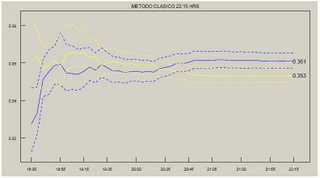
El comité técnico del IFE hizo tres estimaciones distintas para su conteo rápido. Como había un traslape en los intervalos de confianza en dos de tres estimaciones, el consejo prefirió no declarar un ganador más probable.
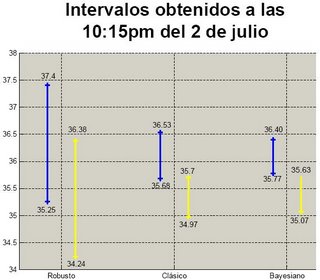 Tal postura fue conservadora y me parece lo más recomendable en una elección cerrada como esta. Hoy el PRD dice que este silencio fue cómplice de un fraude cibérnetico y que el PREP estaba amañado. Sobra decir que es virtualmente imposible amañar un método muestral como el conteo rápido a la par de un método censal como el PREP y hacer que ambos lleguen al un resultado tan similar. Si hacemos una lectura integral del PREP, del conteo rápido del IFE así como las encuestas de salida de otras casas encuestadoras creo que la evidencia es clara en favor de Calderón--AMLO perdió por otras razones.
Una explicación más amplia del conteo rápido del IFE está disponible en:
http://pac.ife.org.mx/download/08/pac_down_informe_Comite-ConteoRapido.pdf

El comité técnico del IFE hizo tres estimaciones distintas para su conteo rápido. Como había un traslape en los intervalos de confianza en dos de tres estimaciones, el consejo prefirió no declarar un ganador más probable.
 Tal postura fue conservadora y me parece lo más recomendable en una elección cerrada como esta. Hoy el PRD dice que este silencio fue cómplice de un fraude cibérnetico y que el PREP estaba amañado. Sobra decir que es virtualmente imposible amañar un método muestral como el conteo rápido a la par de un método censal como el PREP y hacer que ambos lleguen al un resultado tan similar. Si hacemos una lectura integral del PREP, del conteo rápido del IFE así como las encuestas de salida de otras casas encuestadoras creo que la evidencia es clara en favor de Calderón--AMLO perdió por otras razones.
Una explicación más amplia del conteo rápido del IFE está disponible en:
http://pac.ife.org.mx/download/08/pac_down_informe_Comite-ConteoRapido.pdf
Friday, June 23, 2006
The Myth Of Creativity
This is Robin Hanson going at it again, this time in Business Week:
The Myth Of Creativity: "Make no mistake: Innovation matters. Nothing is more essential for long-term economic growth. But to get more innovation we may want less, not more, creativity.
The sobering truth is that the dramatic artistic creations or intellectual insights we most admire for their striking 'creativity' matter little for economic growth. Creative new clothes or music may change fashion, but are soon eclipsed by newer fashions. Large and lasting economic innovations, like steam engines or cell phones, are rare and tend to be independently 'invented' by many people. One less visionary would matter little.
Instead, the innovations that matter most are the millions of small changes we constantly make to our billions of daily procedures and arrangements. Such changes do not require free-spirited self-expression. Instead, people quite naturally think of changes as they go about their routine business and social lives.
(...)
"To succeed in academia, my graduate students and I had to learn to be less creative than we were initially inclined to be. Critics complain that schools squelch creativity, but most people are inclined to be more creative on the job than would be truly productive. So schooling is mostly about selecting the smarter and more diligent, and learning to show up day after day to somewhat boring jobs with ambiguous instructions.
What society needs is not more creativity or suggestions for change but better ways to encourage people to focus on important issues, identify the most promising ideas, and tell the right people about them. But our deification of creativity gets in the way."
The Myth Of Creativity: "Make no mistake: Innovation matters. Nothing is more essential for long-term economic growth. But to get more innovation we may want less, not more, creativity.
The sobering truth is that the dramatic artistic creations or intellectual insights we most admire for their striking 'creativity' matter little for economic growth. Creative new clothes or music may change fashion, but are soon eclipsed by newer fashions. Large and lasting economic innovations, like steam engines or cell phones, are rare and tend to be independently 'invented' by many people. One less visionary would matter little.
Instead, the innovations that matter most are the millions of small changes we constantly make to our billions of daily procedures and arrangements. Such changes do not require free-spirited self-expression. Instead, people quite naturally think of changes as they go about their routine business and social lives.
(...)
"To succeed in academia, my graduate students and I had to learn to be less creative than we were initially inclined to be. Critics complain that schools squelch creativity, but most people are inclined to be more creative on the job than would be truly productive. So schooling is mostly about selecting the smarter and more diligent, and learning to show up day after day to somewhat boring jobs with ambiguous instructions.
What society needs is not more creativity or suggestions for change but better ways to encourage people to focus on important issues, identify the most promising ideas, and tell the right people about them. But our deification of creativity gets in the way."
Friday, June 16, 2006
Welfare States, Unemployment, and Growth
'Real (_____) jobless rate: 15%':
Guess wich country they are talking about (in the blank)...
_______'s unemployment rate is 15 per cent, three times the figure being used by the government, according to new research from McKinsey Global Institute, the think tank.
The consultancy's calculations indicate unemployment is set to rise further, with between 100,000 and 200,000 jobs outsourced to cheaper countries over the next 10 years if no corrective action is taken.
The numbers cast a pall over ______'s international reputation as a thriving welfare state with low unemployment and will help focus attention on jobs ahead of _______ national elections.
McKinsey reached its conclusions by including those who want to work and those who could do so, meaning people on government programmes as well as those on prolonged sick leave.
In its first assessment of the country's economy since 1995, it said: '_______'s economy has reached a critical juncture. If nothing is done, the problems will become much more serious.'
It praised _______ for achieving average GDP growth of 2.7 per cent a year since 1995, which it attibuted to deregulation and improvements in private sector productivity. But it said the country could not rely on future improvements in private-sector productivity, as the catch-up effect that had driven these developments would decline over time.
The ageing population would put the public sector under 'intolerable pressure' unless productivity improved, it added.
'If nothing else changes, the resulting increase in welfare costs would become too large to finance through the current tax system in only 10 to 20 years,' McKinsey said.
(...) income tax rates would have to rise from about 30 per cent to about 50 per cent, arguing that these rises would not be accepted by the public as welfare and health services would decline.
Last, it said that the real unemployment rate of 15 per cent could increase as the production of goods and services moved to lower-cost countries - such as _________.
"______ needs to move quickly to introduce reforms that would create favourable conditions for sustained productivity growth in the private sector, better performance in the public sector and the creation of jobs in the private services sector".
It expressed confidence the country would be able to respond to these challenges, praising its productive industries, macroeconomic stability and good relations between politicians, companies and unions.
But McKinsey said that _______ had a lot of lost ground to regain. According to the Organisation for Economic Co-operation and Development, _______ had dropped from fifth position in its welfare ranking to 12th in 2004.
They are talking about Sweden, a rich country with a supposedly thriving welfare state... Do you get the hint? Thriving welfare states do not produce sustained growth. Sustained growth, in Sweden as well as everywhere else, comes from productivity growth... and welfarist policies do not correlate well with productivity. Think about that the next time you see a candidate promising you a welfarist wonderland.
Guess wich country they are talking about (in the blank)...
_______'s unemployment rate is 15 per cent, three times the figure being used by the government, according to new research from McKinsey Global Institute, the think tank.
The consultancy's calculations indicate unemployment is set to rise further, with between 100,000 and 200,000 jobs outsourced to cheaper countries over the next 10 years if no corrective action is taken.
The numbers cast a pall over ______'s international reputation as a thriving welfare state with low unemployment and will help focus attention on jobs ahead of _______ national elections.
McKinsey reached its conclusions by including those who want to work and those who could do so, meaning people on government programmes as well as those on prolonged sick leave.
In its first assessment of the country's economy since 1995, it said: '_______'s economy has reached a critical juncture. If nothing is done, the problems will become much more serious.'
It praised _______ for achieving average GDP growth of 2.7 per cent a year since 1995, which it attibuted to deregulation and improvements in private sector productivity. But it said the country could not rely on future improvements in private-sector productivity, as the catch-up effect that had driven these developments would decline over time.
The ageing population would put the public sector under 'intolerable pressure' unless productivity improved, it added.
'If nothing else changes, the resulting increase in welfare costs would become too large to finance through the current tax system in only 10 to 20 years,' McKinsey said.
(...) income tax rates would have to rise from about 30 per cent to about 50 per cent, arguing that these rises would not be accepted by the public as welfare and health services would decline.
Last, it said that the real unemployment rate of 15 per cent could increase as the production of goods and services moved to lower-cost countries - such as _________.
"______ needs to move quickly to introduce reforms that would create favourable conditions for sustained productivity growth in the private sector, better performance in the public sector and the creation of jobs in the private services sector".
It expressed confidence the country would be able to respond to these challenges, praising its productive industries, macroeconomic stability and good relations between politicians, companies and unions.
But McKinsey said that _______ had a lot of lost ground to regain. According to the Organisation for Economic Co-operation and Development, _______ had dropped from fifth position in its welfare ranking to 12th in 2004.
They are talking about Sweden, a rich country with a supposedly thriving welfare state... Do you get the hint? Thriving welfare states do not produce sustained growth. Sustained growth, in Sweden as well as everywhere else, comes from productivity growth... and welfarist policies do not correlate well with productivity. Think about that the next time you see a candidate promising you a welfarist wonderland.
Wednesday, June 14, 2006
Life changing readings
"Lisa Jardine and Annie Watkins, from the University of London's Queen Mary College, interviewed 500 men - many of whom had a professional connection with literature - about the novels that had changed their lives. (...)
The novel that means most to men is about indifference, alienation and lack of emotional response. The novel that means most to women is about deeply held feelings and a struggle to overcome circumstances and passion."
Here are the top 10 books for men and women:
MEN'S LIST
1 Albert Camus The Outsider
2 J.D. Salinger The Catcher in the Rye
3 Kurt Vonnegut Slaughterhouse-Five
4 Gabriel Garcia Marquez One Hundred Years of Solitude
5 J.R.R. Tolkien The Hobbit
6 Joseph Heller Catch-22
7 George Orwell 1984
8 F. Scott Fitzgerald The Great Gatsby
9 Milan Kundera The Book of Laughter and Forgetting
10 Harper Lee To Kill a Mockingbird
WOMEN'S LIST
1 Charlotte Bronte Jane Eyre
2 Emily Bronte Wuthering Heights
3 Margaret Atwood The Handmaid's Tale
4 George Eliot Middlemarch
5 Jane Austen Pride and Prejudice
6 Toni Morrison Beloved
7 Doris Lessing The Golden Notebook
8 Joseph Heller Catch-22
9 Marcel Proust Remembrance of Things Past
10 Jane Austen Persuasion
A related question:
Why We Read Fiction: Theory of Mind and the Novel, by Lisa Zunshine, who teaches English at the University of Kentucky. (...) We have an "evolved cognitive predisposition to attribute states of mind to ourselves and others" that is also known as "mind-reading." "These cognitive mechanisms," writes Zunshine, "evolved to process information about thoughts and feelings of human beings, seem to be constantly on the alert, checking out their environment for cues that fit their input conditions. On some level, works of fiction manage to cheat these mechanisms into believing that they are in the presence of material that they were 'designed' to process, i.e., that they are in the presence of agents endowed with a potential for a rich array of intentional stances."
The novel that means most to men is about indifference, alienation and lack of emotional response. The novel that means most to women is about deeply held feelings and a struggle to overcome circumstances and passion."
Here are the top 10 books for men and women:
MEN'S LIST
1 Albert Camus The Outsider
2 J.D. Salinger The Catcher in the Rye
3 Kurt Vonnegut Slaughterhouse-Five
4 Gabriel Garcia Marquez One Hundred Years of Solitude
5 J.R.R. Tolkien The Hobbit
6 Joseph Heller Catch-22
7 George Orwell 1984
8 F. Scott Fitzgerald The Great Gatsby
9 Milan Kundera The Book of Laughter and Forgetting
10 Harper Lee To Kill a Mockingbird
WOMEN'S LIST
1 Charlotte Bronte Jane Eyre
2 Emily Bronte Wuthering Heights
3 Margaret Atwood The Handmaid's Tale
4 George Eliot Middlemarch
5 Jane Austen Pride and Prejudice
6 Toni Morrison Beloved
7 Doris Lessing The Golden Notebook
8 Joseph Heller Catch-22
9 Marcel Proust Remembrance of Things Past
10 Jane Austen Persuasion
A related question:
Why We Read Fiction: Theory of Mind and the Novel, by Lisa Zunshine, who teaches English at the University of Kentucky. (...) We have an "evolved cognitive predisposition to attribute states of mind to ourselves and others" that is also known as "mind-reading." "These cognitive mechanisms," writes Zunshine, "evolved to process information about thoughts and feelings of human beings, seem to be constantly on the alert, checking out their environment for cues that fit their input conditions. On some level, works of fiction manage to cheat these mechanisms into believing that they are in the presence of material that they were 'designed' to process, i.e., that they are in the presence of agents endowed with a potential for a rich array of intentional stances."
Friday, June 09, 2006
The next revolution--not a bohemian one
The next industrial revolution will occur within the next hundred years... no, wait, it will happen within the next five years. Sounds incredible? Well, you have to look at the big picture and think accordingly big. This is exactly how Robin Hanson looks at it (and by the way, it has nothing to do with bohemian free-spirits):
Economic growth is terribly important. Small differences in growth rates eventually overwhelm most other considerations, so the clustering and innovation externalities that create growth differences deserve far more public attention. Unfortunately most people yawn at growth theory; they prefer stories about conflict, status, moral fiber, heroes, and epic changes.
(...)
A postcard summary of life, the universe, and everything could go as follows.
(...)
A postcard summary of life, the universe, and everything could go as follows.
In a universe that was doubling in size about every ten billion years, life and animals appeared on Earth. The largest animal brains then doubled in size every thirty million years. About two million years ago humans achieved important brain innovations, and the number of humans then doubled every quarter million years. About ten thousand years ago we learned to farm instead of hunt, and the human sphere then doubled every thousand years. Finally the industrial revolution occurred, and the world economy has since been doubling every fifteen years.
Our history has thus been a sequence of steady exponential growth modes, with sudden transitions between them. Could yet another new mode appear soon, growing even faster?
Looking at the number of doublings each previous mode experienced before the next mode showed up suggests that a new mode should appear sometime in the twenty-first century. Since each mode grew over one hundred times faster than the previous mode, the next economic mode should double every week or two. And since each transition has taken less time than the previous doubling time, the next transition would take less than fifteen years.
You should read the whole thing here.
Monday, May 29, 2006
American middle class bio
Si te pidieran describir como tu "clase social" ha afectado tu vida, serías capaz de publicarlo en internet? Bryan Caplan (americano, BA de Berkeley, doctorado en Princeton, padre de dos gemelitos), no tiene ningún problema:
"My childhood would have been much worse if I had grown up poor, but frankly, I doubt that my adult life would have been very different. As long as I had enough to eat, poverty per se wouldn't have bothered me much. But based on my experience with non-ability-tracked classes, I would have been friendless and bored out of my mind. (These days, perhaps, I could have found solace on the internet at a public school or library). By the time I finished high school, though, there would probably have been plenty of scholarship money available for me. Even if there weren't, I would have been fanatically motivated to put myself through college in order to escape from my origins.
You could say that growing up poor would have stifled my mental development, but I doubt it. Twin and adoption studies show that childhood environment has little or no long-run effect on IQ. You could say that growing up poor would have changed my attitudes. But I'm a difficult person to mould. I'm an atheist despite sixteen years of my mother's Catholic indoctrination. If anything, I think that growing up poor would have made me more elitist than I already am, just as growing up Catholic made me more impious.
For my adult life to have been radically different, I would probably have needed to grow up in an absolutely poor family in the Third World, not a relatively poor family in the First World. My instinct in that situation would be to learn English and migrate to the U.S., but immigration restrictions would get in the way. This realization is part of the reason I have so much more sympathy for immigrants than I do for low-skilled Americans."
Wednesday, May 24, 2006
Comparative Economic History
Hace unos meses hubo una conferencia en Harvard sobre "The New Comparative Economic History". El programa y varios de los papers están disponibles en:
Este es uno particularmente interesante:
Democracy and Protectionism
Kevin H. O'Rourke, Alan M. Taylor
NBER Working Paper No. 12250, May 2006, NBER Program(s): DAE ITI
Abstract
Does democracy encourage free trade? It depends. Broadening the franchise involves transferring power from non-elected elites to the wider population, most of whom will be workers. The Hecksher-Ohlin-Stolper-Samuelson logic says that democratization should lead to more liberal trade policies in countries where workers stand to gain from free trade; and to more protectionist policies in countries where workers will benefit from the imposition of tariffs and quotas. We test and confirm these political economy implications of trade theory hypothesis using data on democracy, factor endowments, and protection in the late nineteenth century.
Tuesday, May 23, 2006
Measuring the unmeasurable: happiness research
Dan Gilbert doesn't have an instruction manual that tells you how to be happy in four easy steps and one hard one. Nor is he the kind of thinker who needs Freud, Marx, and Modernism to explain the human condition.
Gilbert, the Director of Harvard's Hedonic Psychology Laboratory, is a scientist who explores what philosophy, psychology, neuroscience, and behavioral economics have to teach us about how, and how well the human brain can imagine its own future, and about how, and how well it can predict which of those futures it will most enjoy.
Below he talks about a wide range of matters that include how we measure a person's subjective emotional experience; the role of "positive hedonic experience"; science as an attempt to replace qualitative distinctions with quantitative distinctions; the role negative emotions play in our lives; the costs of variety; and the need to abandon the romantic notion that human unhappiness results from the loss of our primal innocence.
—John Brockman JB

He is the author of the recently published Stumbling on Happiness.
Wednesday, May 17, 2006
Open Letter on Immigration
This is an open letter from Alex Tabarrok (GMU, Independent Institute). The link also provides valuable references on this issue.
"Dear President George W. Bush and All Members of Congress:
People from around the world are drawn to America for its promise of freedom and opportunity. That promise has been fulfilled for the tens of millions of immigrants who came here in the twentieth century.
Throughout our history as an immigrant nation, those who are already here worry about the impact of newcomers. Yet, over time, immigrants have become part of a richer America, richer both economically and culturally. The current debate over immigration is a healthy part of a democratic society, but as economists and other social scientists we are concerned that some of the fundamental economics of immigration are too often obscured by misguided commentary.
Overall, immigration has been a net gain for existing American citizens, though a modest one in proportion to the size of our 12 trillion-dollar economy.
Immigrants do not take American jobs. The American economy can create as many jobs as there are workers willing to work so long as labor markets remain free, flexible and open to all workers on an equal basis.
Immigration in recent decades of low-skilled workers may have lowered the wages of domestic low-skilled workers, but the effect is likely to be small, with estimates of wage reductions for high-school dropouts ranging from eight percent to as little as zero percent.
While a small percentage of native-born Americans may be harmed by immigration, vastly more Americans benefit from the contributions that immigrants make to our economy, including lower consumer prices. As with trade in goods and services, the gains from immigration outweigh the losses. The effect of all immigration on low-skilled workers is very likely positive as many immigrants bring skills, capital and entrepreneurship to the American economy.
Legitimate concerns about the impact of immigration on the poorest Americans should not be addressed by penalizing even poorer immigrants. Instead, we should promote policies, such as improving our education system that enables Americans to be more productive with high-wage skills.
We must not forget that the gains to immigrants from coming to the United States are immense. Immigration is the greatest anti-poverty program ever devised. The American dream is a reality for many immigrants who not only increase their own living standards but who also send billions of dollars of their money back to their families in their home countries—a form of truly effective foreign aid...
America is a generous and open country and these qualities make America a beacon to the world. We should not let exaggerated fears dim that beacon."
"Dear President George W. Bush and All Members of Congress:
People from around the world are drawn to America for its promise of freedom and opportunity. That promise has been fulfilled for the tens of millions of immigrants who came here in the twentieth century.
Throughout our history as an immigrant nation, those who are already here worry about the impact of newcomers. Yet, over time, immigrants have become part of a richer America, richer both economically and culturally. The current debate over immigration is a healthy part of a democratic society, but as economists and other social scientists we are concerned that some of the fundamental economics of immigration are too often obscured by misguided commentary.
Overall, immigration has been a net gain for existing American citizens, though a modest one in proportion to the size of our 12 trillion-dollar economy.
Immigrants do not take American jobs. The American economy can create as many jobs as there are workers willing to work so long as labor markets remain free, flexible and open to all workers on an equal basis.
Immigration in recent decades of low-skilled workers may have lowered the wages of domestic low-skilled workers, but the effect is likely to be small, with estimates of wage reductions for high-school dropouts ranging from eight percent to as little as zero percent.
While a small percentage of native-born Americans may be harmed by immigration, vastly more Americans benefit from the contributions that immigrants make to our economy, including lower consumer prices. As with trade in goods and services, the gains from immigration outweigh the losses. The effect of all immigration on low-skilled workers is very likely positive as many immigrants bring skills, capital and entrepreneurship to the American economy.
Legitimate concerns about the impact of immigration on the poorest Americans should not be addressed by penalizing even poorer immigrants. Instead, we should promote policies, such as improving our education system that enables Americans to be more productive with high-wage skills.
We must not forget that the gains to immigrants from coming to the United States are immense. Immigration is the greatest anti-poverty program ever devised. The American dream is a reality for many immigrants who not only increase their own living standards but who also send billions of dollars of their money back to their families in their home countries—a form of truly effective foreign aid...
America is a generous and open country and these qualities make America a beacon to the world. We should not let exaggerated fears dim that beacon."
Unskilled immigrants
Mercatus Center - Hey, don't bad-mouth unskilled immigrants: You don't have to be a computer genius to be good for the U.S.:
Yes, immigration brings some real costs. But most of these problems are concentrated in a few border and urban areas; federal policy can help correct the imbalances.
Americans have heard from politicians for more than 200 years that immigration will cause the sky to fall. Yet each time it has only made us stronger.
Yes, immigration brings some real costs. But most of these problems are concentrated in a few border and urban areas; federal policy can help correct the imbalances.
Americans have heard from politicians for more than 200 years that immigration will cause the sky to fall. Yet each time it has only made us stronger.
Saturday, May 13, 2006
Public universities, public failure?
This is from the may 12, 2006, New York Times:
There are 32,000 students (...) but no student center, no bookstore, no student-run newspaper, no freshman orientation, no corporate recruiting system. The 480,000-volume central library is open only 10 hours a day, closed on Sundays and holidays. Only 30 of the library's 100 computers have Internet access. The campus cafeterias close after lunch. Professors often do not have office hours; many have no office. Some classrooms are so overcrowded that at exam time many students have to find seats elsewhere. By late afternoon every day the campus is largely empty.
(Sounds like a familiar university? Think again.)
Sandwiched between a prison and an unemployment office just outside Paris, the university here is neither the best nor the worst place to study in this fairly wealthy country. Rather, it reflects the crisis of France's archaic state-owned university system: overcrowded, underfinanced, disorganized and resistant to the changes demanded by the outside world.
Read the rest here:
Alex Tabarrok reflects on the US vs. French system:
The United State's has one of the most admired university systems in the world and one of the most deplored k-12 systems. Could the difference have something to do with the fact that universities operate in a competitive market with lots of private suppliers while k-12 is dominated by monopolistic, government provided schools?
What would our university system look like if it operated like the k-12 system?
Look to France for the answer. The riots of 1968 forced the government to offer a virtually free university education to any student who passes an exam but as a result the universities are woefully underfunded especially for the masses. Amazingly, with just a few exceptions for the elites, students are required to attend the universities closest to their high schools. Sound familiar?
-----
Well, many public universities in the US are pretty good--perhaps due to the competition with private ones? To be sure, one would have to look at a large sample of university systems (public, private, mixed) to determine whether public universities work or not, and why. But it seems like France would be an underperformer in such a comparison.
Wednesday, April 26, 2006
Everybody was an intellectual last night
Last night every single pundit, analyst and intellectual was captured by the debate on the debate. Me? I had to report to our neighbor country:
Barbs fly at Mexico's first presidential debate
EX-MAYOR OF MEXICO CITY, THE FRONT-RUNNER IN JULY RACE, SKIPS TELEVISED EVENT
By Edwin Garcia
Knight Ridder Mexico Bureau
MEXICO CITY - The first presidential debate leading to this summer's election featured harsh criticism Tuesday among the candidates -- and an occasional reference to the man who was supposed to occupy one of the podiums on the stage.
Andres Manuel Lopez Obrador, the left-of-center former Mexico City mayor who mobilized millions of followers and long-ago gained front-runner status heading toward the July 2 vote, skipped the nationally televised debate.
"It's not common in presidential elections that a candidate decides not to go to a debate,'' said political scientist Francisco Javier Aparicio of the Center for Economics, Research and Education in Mexico City. "I don't know why he believes it was better not to go.''
But the two-hour debate at Mexico's World Trade Center nonetheless included frequent clashes between ruling National Action Party candidate Felipe Calderon Hinojosa, running second in most polls, and third-place candidate Roberto Madrazo, whose Institutional Revolutionary Party saw its 71-year grip on power end with the election of President Vicente Fox six years ago.
Barbs fly at Mexico's first presidential debate
EX-MAYOR OF MEXICO CITY, THE FRONT-RUNNER IN JULY RACE, SKIPS TELEVISED EVENT
By Edwin Garcia
Knight Ridder Mexico Bureau
MEXICO CITY - The first presidential debate leading to this summer's election featured harsh criticism Tuesday among the candidates -- and an occasional reference to the man who was supposed to occupy one of the podiums on the stage.
Andres Manuel Lopez Obrador, the left-of-center former Mexico City mayor who mobilized millions of followers and long-ago gained front-runner status heading toward the July 2 vote, skipped the nationally televised debate.
"It's not common in presidential elections that a candidate decides not to go to a debate,'' said political scientist Francisco Javier Aparicio of the Center for Economics, Research and Education in Mexico City. "I don't know why he believes it was better not to go.''
But the two-hour debate at Mexico's World Trade Center nonetheless included frequent clashes between ruling National Action Party candidate Felipe Calderon Hinojosa, running second in most polls, and third-place candidate Roberto Madrazo, whose Institutional Revolutionary Party saw its 71-year grip on power end with the election of President Vicente Fox six years ago.
Saturday, April 22, 2006
How to rally, San Francisco style
You cannot miss this nice exercise in photojournalism... with lots of ideas for when you decide to join the anti-whatever revolution!
"On March 18, 2006, activist groups around the world held protests to mark the third anniversary of the invasion of Iraq. San Francisco was no exception: the communist anti-war group ANSWER planned to stage a large rally and march through the city, in opposition to the war and other American policies.
The problem is, other groups also planned additional anti-war and anti-authoritarian events in San Francisco (and nearby) on March 18. And all the events were conflicting with each other. Something obviously had gone terribly awry in the progressive community. In the weeks leading up to the big day, the different factions began bickering with each other.
The most glaring scheduling snafu involved the Anarchist Bookfair, which was being held on the other side of San Francisco from the ANSWER march, but on the same day at the exact same time. Seeing as the anarchist event and the anti-war event both drew on the same pool of potential attendees, accusations began to fly that each event was going to hurt attendance at the rival event. "
San Francisco is an interesting place indeed--Take a look at the pictures on these links:
The "Global Day of Action" rally and Anarchist Bookfair -- San Francisco, March 18, 2006
And do not miss part 2:
The Anarchist Bookfair 2006
"On March 18, 2006, activist groups around the world held protests to mark the third anniversary of the invasion of Iraq. San Francisco was no exception: the communist anti-war group ANSWER planned to stage a large rally and march through the city, in opposition to the war and other American policies.
The problem is, other groups also planned additional anti-war and anti-authoritarian events in San Francisco (and nearby) on March 18. And all the events were conflicting with each other. Something obviously had gone terribly awry in the progressive community. In the weeks leading up to the big day, the different factions began bickering with each other.
The most glaring scheduling snafu involved the Anarchist Bookfair, which was being held on the other side of San Francisco from the ANSWER march, but on the same day at the exact same time. Seeing as the anarchist event and the anti-war event both drew on the same pool of potential attendees, accusations began to fly that each event was going to hurt attendance at the rival event. "
San Francisco is an interesting place indeed--Take a look at the pictures on these links:
The "Global Day of Action" rally and Anarchist Bookfair -- San Francisco, March 18, 2006
And do not miss part 2:
The Anarchist Bookfair 2006
Wednesday, April 19, 2006
Hurting candidate's feelings
Pundits don't like negative campaigning. I do. At the very minimum, negative campaigning has a screening effect: people with questionable records will not bother to become candidates--and that is important if you only have a say every 6 years. But does negative campaigning work? Does it hurt somebody's feelings, other than the pundits? Here is some evidence... with videos included.
Going Negative
Advertising Tone Manipulations

How negative campaigns shrink electorate, manipulate news media
Once upon a time, this country divided itself neatly along party lines. Most people voted; those who did not fended to be poorer, less well educated, and more apathetic, but still party loyal. Television has changed all that. Now, we are split by a new division: between loyalists and apathetics. On the one hand, media propaganda can often shore up loyalists to vote for their traditional party; on the other hand, that same propaganda is increasingly peeling off a band of citizens who turn from independence to apathy, even antipathy, toward our political institutions.
Are interest groups good for you?
This is Donald Wittman on Pressure Groups, Political Advertising and Uninformed Voters:
"Contrary to the view of many, the models presented here suggest that even uninformed voters can respond rationally to political advertising and that campaign donations and endorsements by special interests tend to move the outcome toward, instead of away from, the median voter.
The following question naturally arises. If, as argued in this paper, campaign contributions by pressure groups aid the democratic process, then why do we see so many attempts like the McCain-Feingold bill to put limits on campaign financing? The answer lies in this paper, also. As we have seen, pressure group contributions to political campaigns hurt some of the participants – informed voters on average and those informed voters whose preferences run contrary to the median uninformed voter in particular, as well as those policy-preferring candidates whose preferences are more aligned with the median informed voter than with the median uninformed voter. It is not surprising that these actors and their supporters would be against unlimited campaign financing.
Pressure groups have often been viewed as the bad guys of democracy. But “special interests” is just a pair of words meaning self interest, and from Adam Smith onward, we know that "it is not from the benevolence of the butcher or the brewer ... that we expect our dinner, but from their regard to their own interest." Here I have argued that the invisible hand works for pressure groups also. Instead of viewing pressure groups as undermining the democratic process, it may be more enlightening to view them as institutions that reduce transaction costs. Just as speculators (who were once thought of as the bad guys of financial markets) are now seen as transaction-cost reducers, pressure groups need to be seen in a similar light. Once we have altered our perspective, we are primed for a new research agenda. For example, why efficiency would lead special interests to be organized in the way that they are and how or why they are different from political parties.
Perhaps even more important than the change in perspective on pressure groups is the added understanding on how uniformed voters can rationally respond to political advertising. This paper has shown how uninformed voters can make use of optimal rules of thumb that cannot be manipulated by candidates or pressure groups. Future work will no doubt consider still different information sets available to the uninformed and how the strategy of the uninformed voters changes in response to the changes in the information available."
The following question naturally arises. If, as argued in this paper, campaign contributions by pressure groups aid the democratic process, then why do we see so many attempts like the McCain-Feingold bill to put limits on campaign financing? The answer lies in this paper, also. As we have seen, pressure group contributions to political campaigns hurt some of the participants – informed voters on average and those informed voters whose preferences run contrary to the median uninformed voter in particular, as well as those policy-preferring candidates whose preferences are more aligned with the median informed voter than with the median uninformed voter. It is not surprising that these actors and their supporters would be against unlimited campaign financing.
Pressure groups have often been viewed as the bad guys of democracy. But “special interests” is just a pair of words meaning self interest, and from Adam Smith onward, we know that "it is not from the benevolence of the butcher or the brewer ... that we expect our dinner, but from their regard to their own interest." Here I have argued that the invisible hand works for pressure groups also. Instead of viewing pressure groups as undermining the democratic process, it may be more enlightening to view them as institutions that reduce transaction costs. Just as speculators (who were once thought of as the bad guys of financial markets) are now seen as transaction-cost reducers, pressure groups need to be seen in a similar light. Once we have altered our perspective, we are primed for a new research agenda. For example, why efficiency would lead special interests to be organized in the way that they are and how or why they are different from political parties.
Perhaps even more important than the change in perspective on pressure groups is the added understanding on how uniformed voters can rationally respond to political advertising. This paper has shown how uninformed voters can make use of optimal rules of thumb that cannot be manipulated by candidates or pressure groups. Future work will no doubt consider still different information sets available to the uninformed and how the strategy of the uninformed voters changes in response to the changes in the information available."
Subscribe to:
Posts (Atom)
